e

  • 22 Posts
  • 1.08K Comments
Joined 3 years ago
cake
Cake day: June 15th, 2023

help-circle
  • Copy the link of the image. You see the bit at the end of the url that says ?format=webp? Change that to ?format=png.

    Lemmy often doesn’t show images in original quality unless specifically requested to.

    Edit: which is fair, because the lossy webp is 51 kb vs 513 for the png. Compressed for longer, it could be a 265 kb lossless jxl though. Once Mozilla and Google finally add support (which is actually happening now!). It could also be a 322 kb lossless avif. All of these aren’t max effort, just the effort that takes about 6 seconds on Image Toolbox on my phone

    Lossily, avif > webp > mozjpeg > jxl > jpegli for this image, although I think this is just because jxl and jpegli use the same perpetual tuning method which must not favor dark areas. Which might be good for most images but certainly is terrible for this one. It certainly is much better at the bright areas. Mozjpeg vs jxl -> lossless webp (equivalent compressed size)

    Note that all of the lossless formats would have been much smaller if the original screenshot in the mastodon post was lossless


  • Motion blur in video games is usually a whole lot less accurate at what it’s trying to approximate than averaging 4 frame generation frames would be. Although 4 frame generation frames would be a lot slower to compute than the approximations people normally make for motion blur.

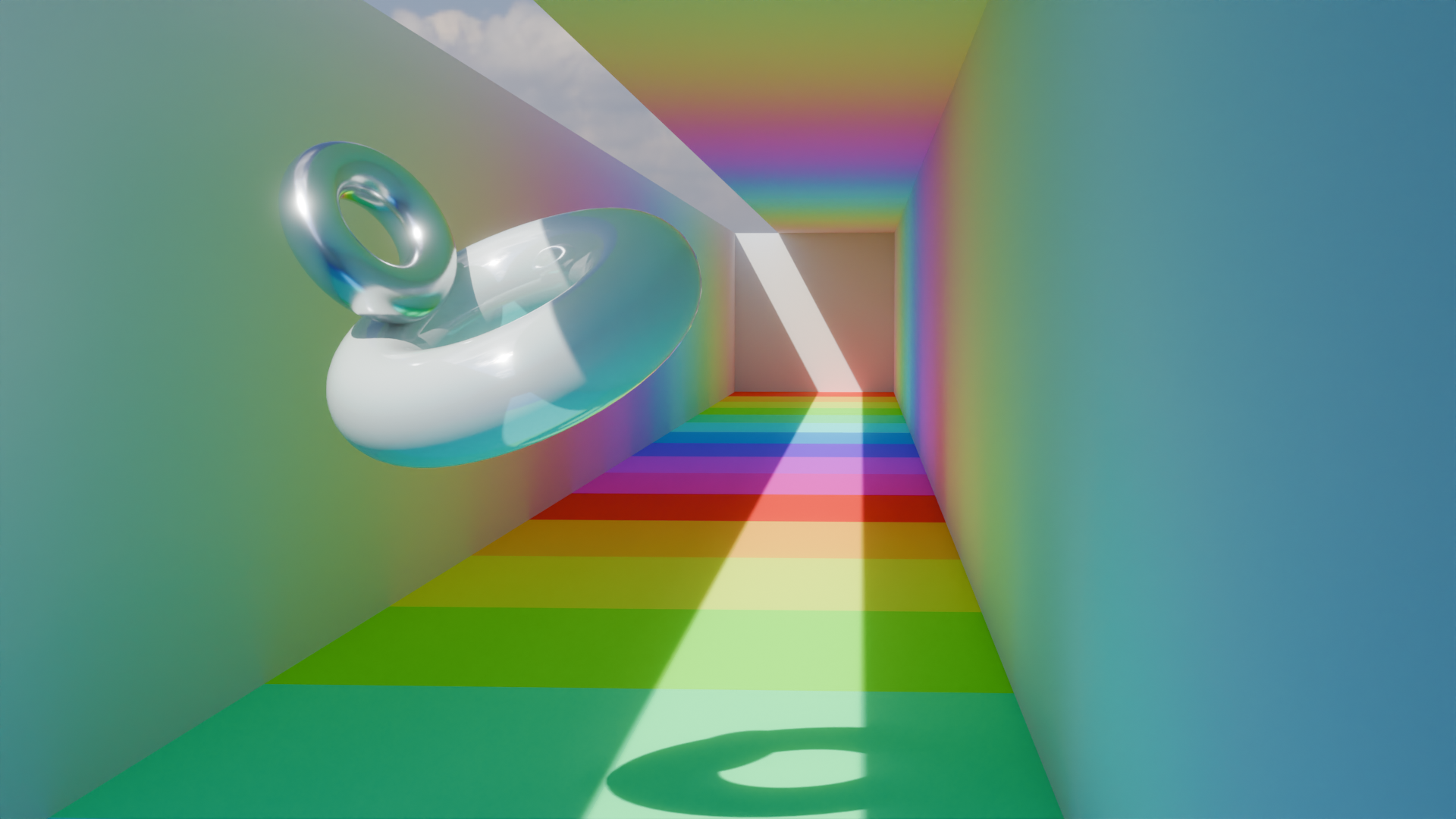
    Yes, motion blur in video games is just an approximation and usually has a lot of visible failure cases (disocclusion, blurred shadows, rotary blur sometimes). It obviously can’t recreate the effect of a fast blinking light moving across the screen during a frame. It can be a pretty good approximation in the better implementations, but the only real way to ‘do it properly’ is by rendering frames multiple times per shown frame or rendering stochastically (not really possible with rasterization and obviously introduces noise). Perfect motion blur would be the average of an infinite number of frames over the period of time between the current frame and the last one. With path tracing you can do the rendering stochastically, and you need a denoiser anyways, so you can actually get very accurate motion blur. As the number of samples approaches infinity, the image approaches the correct one.

    Some academics and nvidia researchers have recently coauthored a paper about optimizing path tracing to apply ReSTIR (technique for reusing information across multiple pixels and across time) to scenes with motion blur, and the results look very good (obviously still very noisy, I guess nvidia would want to train another ray reconstruction model for it). It’s also better than normal ReSTIR or Area ReSTIR when there isn’t motion blur apparently. It’s relying on a lot of approximations too, so probably not quite unbiased path tracing quality if allowed to converge, but I don’t really know.

    https://research.nvidia.com/labs/rtr/publication/liu2025splatting/

    But that probably won’t be coming to games for a while, so we’re stuck with either increasing framerates to produce blur naturally (through real or ‘fake’ frames), or approximating blur in a more fake way.


  • DLSS Frame Generation actually uses the game’s analytic motion vectors though instead of trying to estimate them (well, really it does both) so it is a whole lot more accurate. It’s also using a fairly large AI model for the estimation, in comparison to TVs probably just doing basic optical flow or something.

    If it’s actually good though depends on if you care about latency and if you can notice the visual artifacts in the game you’re using it for.


  • Yes, if you’re limited on money you certainly don’t need that much. You could get very similar setup with Seagate’s 8tb drives for like $200. And things don’t need to be stored in archival quality either. Just saying that amount of storage isn’t crazy expensive nowadays.

    Also you forgot the $700 Mac pro wheels lol (yes they cost that much now)