The only alternative to proof of work is proof of stake. And if the world ever ran on proof of stake crypto, it would make today’s wealth inequality look like a Marxist paradise.
What matters is whether or not there’s any significant profit - the reward being bigger than the cost. PoW minimizes this with difficulty adjustment flushing most profits down the toilet. PoS must always have a return competitive with other investments.
Profits should be low, or else it promotes inequality.
You get one asset with worse interest that can be spent (like dollars), and one asset with better interest that can’t be spent (like bonds). The poor hold the former, the rich hold mostly the latter.
If there’s a low barrier to entry then you’re just reinventing POW because someone can run as many nodes as possible with minimal stake in order to maximize returns. Can you give an example of one successful “fixed rewards” Crypto coin?
You are exactly the type of person I’m talking about :\
Crypto is not the only use case for blockchain.
Blockchain can be useful in inherently trusted, closed ecosystems.
Depending on the use case, proof doesn’t even need to be anything more than a valid certificate (not work, not stake)
Consider a bank that develops its own blockchain ledger for internal use only, replacing their branch ledgers (which require daily reconciliation and propagation).
An immutable, distributed ledger has plenty of valid, valuable use cases without looking like crypto.
“Internal use only” blockchain is an oxymoron. If all contributors are trusted entities, then what does it matter if the data is stored in a blockchain vs any other data structure? If anything the amount of extra work to maintain and modify the blockchain in the case of errors just makes it unnecessary.
If that’s the best example of its many “valid, valuable use cases”, then it’s still a pass from me, dawg.
But as long as you can have a trusted central authority, you don’t need blockchain without needing to trust all the clients. The central authority can enforce authentication and authorization for what each client can do, combine with proper logging it is already sufficient. Blockchain is only needed if there’s absolutely no central authority (which is not the case for any traditional business as by nature they already have a hierarchy where the top would act as the central authority, therefore any business that implements blockchain internally is just BS-ing).
Pretty obvious that its use in the first place was some FOMO executives trying to get in on “blockchain” technology, just like they’re doing with AI and LLMs now. Funny how BTC and ETH both plateaued a year ago, right around the time AI became the new thing.
I’m not going to bother reading the rest, I already wasted too much time arguing with a true believer. GL with the crypto that you say you don’t have.
Lol you’re a judgemental prick. I have zero crypto because that shit is absolutely moronic.
It’s like you talked to someone who supports nuclear power and responded “good luck with the nuclear bombs you definitely don’t have, true believer”
Sounds like you just want to hate on shit you don’t understand. Go on with your bad self though 👍
EDIT: LMAO from the article you linked they even point out that the tech itself isn’t the problem, but the willingness of businesses to invest in the improvements (which is, like, an incredibly common problem in business that does not in any way make the tech bad)
Its plan to digitize global supply chains hasn’t received sufficient cooperation and support to remain viable.
That is the downside of corporate blockchain projects. They need everyone to share a mindset and commit to a long-term plan. Unfortunately, businesses face ever-changing conditions and financial problems. Few can warrant the cost of buying into such systems under the current market conditions.
You probably preach about how nuclear power is terrible, how if it were so great there would be more of it, and people sticking to coal is proof that coal power is better.

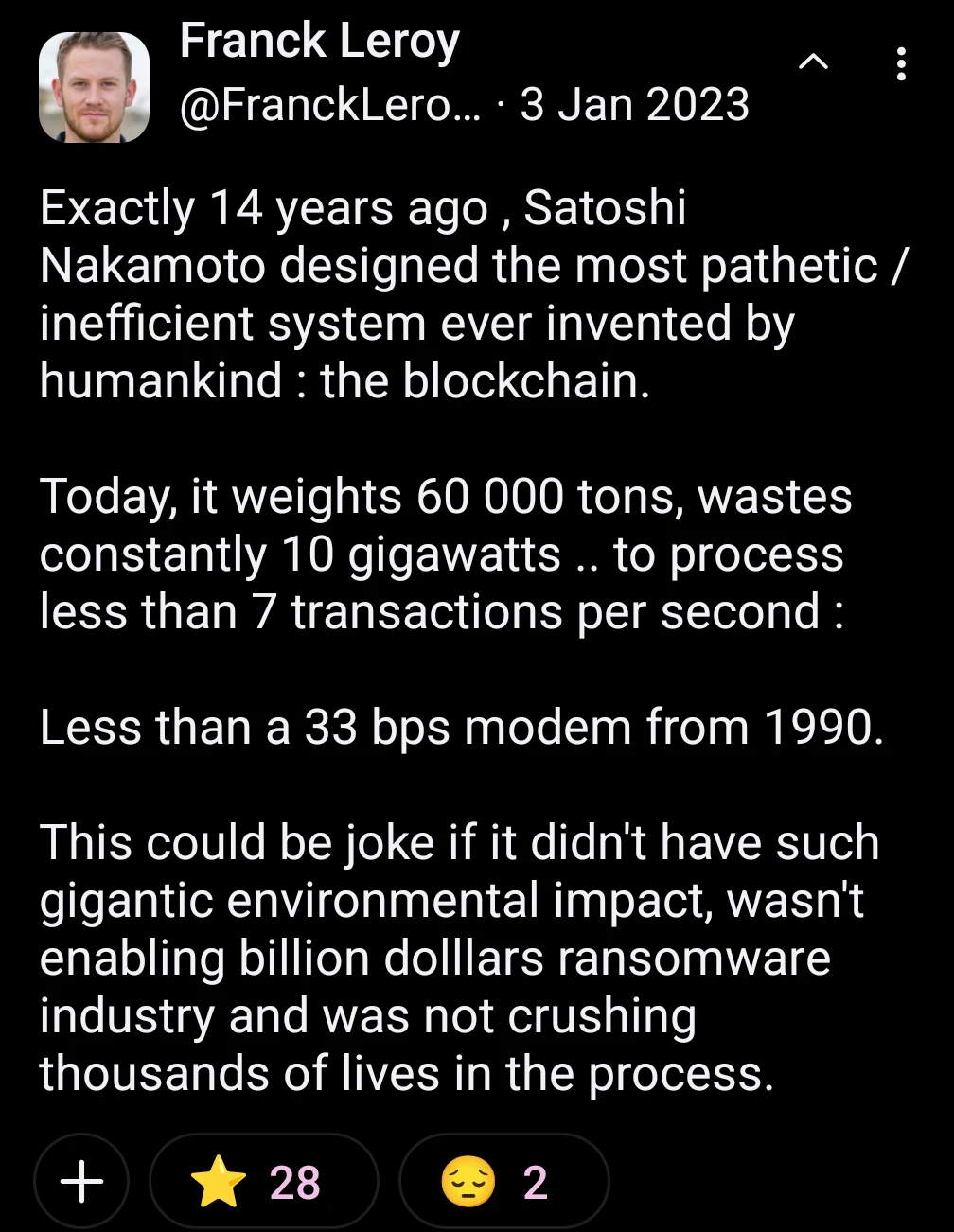
The only alternative to proof of work is proof of stake. And if the world ever ran on proof of stake crypto, it would make today’s wealth inequality look like a Marxist paradise.
There’s other alternatives. But PoS does not reward just by ownership either.
Check out Gnosis, especially Circles, which is creating a UBI type thing.
I just looked at Circles’ webpage, and respectfully, that is a Ponzi scheme.
How exactly is it a Ponzi scheme, when you don’t need to pay to get a share?
Why? If the rewards are fixed and independent of the amount staked then there is no issue.
What matters is whether or not there’s any significant profit - the reward being bigger than the cost. PoW minimizes this with difficulty adjustment flushing most profits down the toilet. PoS must always have a return competitive with other investments.
Profits should be low, or else it promotes inequality.
No. It needs to offer a reward enough to pay the minimum number of validators needed to establish a secure network.
2x the number of stakers means 1/2 the return for each validator, but the network doesn’t care about that.
With too low a return they just invest elsewhere.
You get one asset with worse interest that can be spent (like dollars), and one asset with better interest that can’t be spent (like bonds). The poor hold the former, the rich hold mostly the latter.
Low returns and people leaving is not a problem.
There will still be enough validators to secure the network. The remaining will get a higher return.
What’s the minimum you mentioned earlier?
Minimum Viable Validator Count Ethereum requires at least 2,000-4,000 validators to maintain strong network security. Currently, there are over 900,000 validators actively securing Ethereum, making attacks prohibitively expensive.
If there’s a low barrier to entry then you’re just reinventing POW because someone can run as many nodes as possible with minimal stake in order to maximize returns. Can you give an example of one successful “fixed rewards” Crypto coin?
Ethereum.
The overall network issuance rate is fixed and currently roughly 4.5% per year. If more people stake then less is received per person.
Minimal stake is is $75k per validator.
This stake is slashed if you are dishonest.
You are exactly the type of person I’m talking about :\
Crypto is not the only use case for blockchain.
Blockchain can be useful in inherently trusted, closed ecosystems.
Depending on the use case, proof doesn’t even need to be anything more than a valid certificate (not work, not stake)
Consider a bank that develops its own blockchain ledger for internal use only, replacing their branch ledgers (which require daily reconciliation and propagation).
An immutable, distributed ledger has plenty of valid, valuable use cases without looking like crypto.
“Internal use only” blockchain is an oxymoron. If all contributors are trusted entities, then what does it matter if the data is stored in a blockchain vs any other data structure? If anything the amount of extra work to maintain and modify the blockchain in the case of errors just makes it unnecessary.
If that’s the best example of its many “valid, valuable use cases”, then it’s still a pass from me, dawg.
This is not true, even inside a bank. Employees commit fraud. Branches don’t trust each other.
Once built, maintaining is easy.
Er. The whole point is that blockchains are immutable.
But as long as you can have a trusted central authority, you don’t need blockchain without needing to trust all the clients. The central authority can enforce authentication and authorization for what each client can do, combine with proper logging it is already sufficient. Blockchain is only needed if there’s absolutely no central authority (which is not the case for any traditional business as by nature they already have a hierarchy where the top would act as the central authority, therefore any business that implements blockchain internally is just BS-ing).
How Walmart Canada Uses Blockchain to Solve Supply-Chain Challenges
I have a large number of examples in this comment from four months ago. Please read them: https://lemmy.world/post/36683795/19677963
Literally the first example you gave was shut down a year later: https://www.reddit.com/r/CryptoReality/comments/1mpeh9z/when_crypto_bros_are_asked_for_a_blockchain_use/
Pretty obvious that its use in the first place was some FOMO executives trying to get in on “blockchain” technology, just like they’re doing with AI and LLMs now. Funny how BTC and ETH both plateaued a year ago, right around the time AI became the new thing.
I’m not going to bother reading the rest, I already wasted too much time arguing with a true believer. GL with the crypto that you say you don’t have.
Lol you’re a judgemental prick. I have zero crypto because that shit is absolutely moronic.
It’s like you talked to someone who supports nuclear power and responded “good luck with the nuclear bombs you definitely don’t have, true believer”
Sounds like you just want to hate on shit you don’t understand. Go on with your bad self though 👍
EDIT: LMAO from the article you linked they even point out that the tech itself isn’t the problem, but the willingness of businesses to invest in the improvements (which is, like, an incredibly common problem in business that does not in any way make the tech bad)
You probably preach about how nuclear power is terrible, how if it were so great there would be more of it, and people sticking to coal is proof that coal power is better.
Big brain you’ve got there 😂🫡